

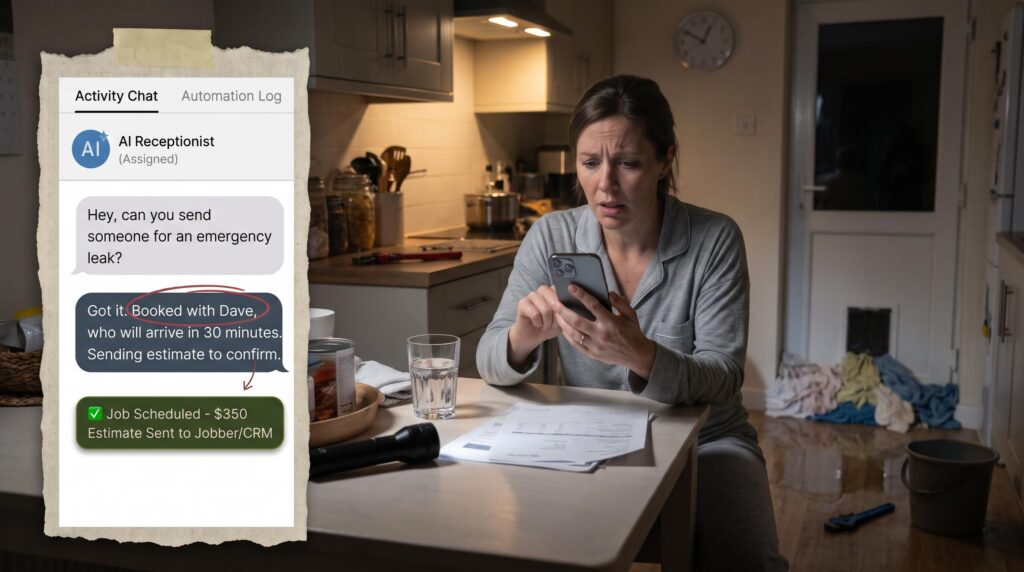
Your crew is up on a roof, the office manager is on another line, and the phone keeps ringing. An unanswered call is a homeowner who may try the next name on the list. An AI receptionist for contractors picks up those calls, asks what your dispatcher would ask, and passes the job details to your team. It works best alongside the contractor marketing that brings the calls in, so the leads you pay for don't end up in voicemail. Below, you'll see what an AI receptionist does and the Alberta privacy rule most guides skip. You'll also see what it costs next to an answering service or a dispatcher, and what to check before you switch one on.
Direct Answer
An AI receptionist is a voice agent that answers a contractor's calls when the team can't, asks set intake questions, and sends job details or urgent alerts to the office. In Alberta, caller details fall under PIPA, and storing calls outside Canada means telling callers how to get your policy.
TL;DR
- An AI receptionist answers overflow and after-hours calls, takes job details and flags urgent jobs.
- For most Calgary contractors, Alberta's PIPA is the main privacy law for caller details, not PIPEDA [1][2].
- If calls are stored outside Canada, callers must be told how to get your policy and who can answer questions [2].
- Job Bank puts the Calgary dispatcher median at $30 an hour, and covering every hour of the week with people takes more than four full-time positions [4].
- Missed call text back covers hang-ups; CASL allows texts for six months after an inquiry, with an opt-out in every text [5][6].
- Test the urgent handoff and keep outbound sales calls within consent rules before going live [7].
One-liner: Answer every call, tell callers where their details go, and test the 2 a.m. emergency first.
Key Numbers
| Stat | What it measures | Source |
|---|---|---|
| $21.00/hr | Calgary Region receptionist median wage | Job Bank, updated Nov. 19, 2025 [3] |
| $30.00/hr | Calgary Region dispatcher median wage | Job Bank, updated Nov. 19, 2025 [4] |
| $21.00 to $46.00/hr | Calgary Region dispatcher wage range | Job Bank, updated Nov. 19, 2025 [4] |
| 94.6% | Alberta dispatchers with at least one non-wage benefit | Job Bank, 2025 [4] |
| 6 months | Implied consent to text after an inquiry | CASL s. 10(10)(e), current to 2026 [5] |
| 10 business days | Deadline to act on an opt-out | CASL s. 11(3), current to 2026 [5] |
| 60 days | How long contact details in a text must stay valid | CASL s. 6(3), current to 2026 [6] |
| $100,000 | Maximum PIPA fine for a company | Government of Alberta, 2025 [2] |
| $10,000 | Maximum PIPA fine for an individual | Government of Alberta, 2025 [2] |
What an AI Receptionist Does for a Contractor
In short: An AI receptionist answers the calls your team can't, asks your intake questions, sends you the details and flags urgent jobs.
An AI receptionist is a voice agent that answers your business line when nobody on your team can. It talks with the caller, asks the questions you set, books or logs the job, and sends your office a written summary, day or night.
You'll also see it called an AI phone receptionist or an AI voice receptionist. It isn't a phone tree that makes callers press 1, and it isn't voicemail. The caller describes the problem in their own words, and the system responds.
For a trade business, the job is narrow and practical. It covers three gaps: calls that come in while everyone is on a job, calls after the office closes, and the overflow when a busy day stacks calls on top of each other.
Picture a roofing company the morning after a summer hailstorm. Two crews are already up on roofs, and the office line won't stop ringing. Without help, some of those callers hear voicemail and move on. With an AI receptionist covering overflow, each caller is answered, gives an address and a description of the damage, and lands in a queue your office works through when the crews check in.
How Does an AI Receptionist Work?
- The call forwards. Calls you don't pick up, or calls outside set hours, forward from your business number to the AI receptionist. Customers still dial the number they already know.
- It asks your questions. The script follows your intake: name, address, what's wrong and how soon they need someone. It can also answer set questions, such as your service area and hours.
- Your team gets the details. A summary goes to your office by text or email, or into your CRM if it's connected. Calls that match your urgent rules, such as no heat or water on the floor, can go straight to whoever is on call.
Once software is answering your phone and saving what callers say, a privacy law covers every call. In Alberta, it's a different law from the one most guides name.
Alberta Privacy Rules for an AI Receptionist: Why PIPA Applies
In short: PIPA is Alberta's main law for caller details. Storage outside Canada adds a notice you have to give.
Canadian AI receptionist guides often point you to PIPEDA, the federal privacy law. For a Calgary plumbing or HVAC company, the main law is Alberta's Personal Information Protection Act (PIPA) [1][2]. That holds for any provincially regulated business in the province. PIPEDA can still apply to federally regulated businesses and to some personal information that crosses provincial or national borders [1].
The difference shows up once a call is recorded. Depending on the provider, an AI receptionist system may keep recordings and transcripts on servers outside Canada. When a service provider outside Canada collects or stores personal information for your business, PIPA asks for two things [2]:
| Where | What PIPA asks for |
|---|---|
| Your written privacy policies | The country where the information is or may be handled, and the purposes the provider may collect, use or disclose it for |
| What callers are told, orally or in writing | How to get your policies on that provider, and the name or title of a person who can answer their questions |
On a phone line, the natural place for that notice is the greeting. A generic greeting says, "Thanks for calling, how can I help?" A greeting set up with PIPA in mind adds one line.
"Thanks for calling Calgary Peak Plumbing. Our automated system may record this call and store transcripts securely outside Canada. For a copy of our privacy policy or questions, ask for our office manager. How can we help with your home today?"
Before you sign with any AI receptionist provider in Canada, ask two questions. Which countries store and process your calls, recordings and transcripts? And which other companies handle that data for them, and what security certifications do they hold?
The stakes are real. A breach that creates a real risk of significant harm must be reported to Alberta's Information and Privacy Commissioner. Breaking PIPA can bring fines of up to $100,000 for a company and up to $10,000 for an individual [2].
This is general information about Alberta privacy law, not legal advice.
AI Receptionist vs AI Answering Service, Live Answering and a Dispatcher
In short: An AI receptionist covers intake at any hour. Scheduling and judgment calls stay with people.
"AI answering service" is often another name for an AI receptionist. Some plans sold under that name only take messages, though, so check what a plan does before you compare prices.
| AI receptionist | AI answering service (message-only plan) | Live answering service | In-house dispatcher | |
|---|---|---|---|---|
| Hours covered | Any hours you set | Any hours you set | Depends on the plan | Their shift |
| Calls at once | Several | Several | Depends on staffing | One |
| Books or routes jobs | Yes, by your rules | No, takes a message | Sometimes, by script | Yes |
| Answers set questions | Yes | Basic answers | Yes, from a script | Yes |
| Upset callers and odd requests | Hands off to a person | Takes a message | Handles some, then passes on | Handles them |
| Knows your techs and schedule | Only what you connect | No | No | Yes |
| How it's paid for | Monthly plan, often tied to calls or minutes | Monthly plan | Monthly plan or per minute | Wage plus benefits |
For a trade, a better question than AI vs human receptionist is which part of the phone job each one should own. A dispatcher does two jobs. One is picking up and taking down the details. The other is running the board: which tech goes where, and what moves when a job runs long. An AI receptionist for trades can take the first job off the desk. The second stays with someone who knows your crews.
Picture 8 a.m. on a cold Monday. Without overflow help, your dispatcher is juggling three lines while trying to reroute a tech whose first call ran long. With an AI receptionist catching the overflow, those callers are logged with an address and the problem. Your dispatcher works the board first, then calls them back in order of urgency.
What an AI Receptionist Costs a Calgary Contractor
In short: Price depends on how calls are billed, how many you get and the setup. A Calgary dispatcher costs about $30 an hour.
AI receptionist pricing varies by provider, and the quote depends on how your calls are counted and how many you get. Before you compare quotes, know what drives the number.
| Cost driver | What to ask |
|---|---|
| Billing unit | Is it priced per call, per minute or as a flat monthly plan? |
| Volume and call length | How many calls or minutes are included, measured against your busiest month? |
| Which calls it takes | After-hours only, daytime overflow, or every call? |
| Connections | Does it link to your CRM, calendar or field service software (such as Jobber or ServiceTitan), and does that cost extra? |
| Setup | Who writes the script, urgent rules and greeting, and is that work included? |
| Overages | What happens to the bill when a storm doubles your calls? |
| Contract and trial | Is it month-to-month, and can you test it on real calls first? |
The people-based benchmark comes from Job Bank's prevailing wages for the Calgary Region, updated November 19, 2025 [3][4]:
| Role | Low | Median | High |
|---|---|---|---|
| Receptionist | $17.00/hr | $21.00/hr | $30.00/hr |
| Dispatcher | $21.00/hr | $30.00/hr | $46.00/hr |
For a trade office, the dispatcher row is the closer match, though Job Bank's group covers all dispatchers, not only trades. At the $30 median, one full-time year (2,080 hours) comes to about $62,400 in wages alone. In Alberta, 94.6% of dispatchers and 68.4% of receptionists also get at least one non-wage benefit, so the full cost runs higher [3][4].
Hours matter as much as the wage. A week has 168 hours, and one full-time person covers 40 of them, under a quarter. Answering every hour with people would take more than four full-time positions. That's where an AI receptionist fits: covering the hours a person can't, not replacing the person you have.
Missed Call Text Back: The Simplest Place to Start
In short: A missed call text back keeps the caller talking to you. CASL sets how long you can keep texting and what each text needs.
Missed call text back sends an automatic text when a call goes unanswered. It catches callers an AI receptionist can miss: people who hang up before the call forwards, and people who would rather text than talk.
A good one reads like a person wrote it: "Hi, it's [your business name]. Sorry we missed your call. What's going on, and what's the address? Reply STOP to opt out."
Missed Call • Today 8:14 AM
Delivered • 8:14 AM
8:16 AM
Delivered • 8:17 AM
Figure 2: Example of an automated CASL-compliant missed-call text sequence that secures caller intent within 3 minutes of a missed ring.
Three rules from Canada's Anti-Spam Legislation (CASL) apply to texts that promote your business [5][6]:
| Rule | What it means for missed call texts |
|---|---|
| Implied consent from an inquiry | A call asking about a job is an inquiry, so you can send follow-up texts for six months from that call |
| What every text must carry | Your business name, contact details that stay valid for at least 60 days, and a way to unsubscribe |
| Opt-outs | When someone replies STOP, it must take effect within 10 business days |
Run it alongside the AI receptionist, and every missed caller gets either a voice or a text reply.
What to Watch Before You Switch It On
In short: Test urgent calls, set the privacy notice, keep outbound sales calls within consent rules, and send summaries to where your team works.
Setup decides how well an AI receptionist works. Check these six points before your callers hear it:
- Urgent call handoff. Decide who gets a no-heat or flooding call at 2 a.m. Then decide what the system does if that person doesn't pick up. A second number to try, or a promised callback time, beats a message that sits until morning.
- The privacy notice. Add the PIPA line to the greeting and update your written policy, as covered above, before the first call is recorded.
- Outbound calls. CRTC rules cover robocalls, meaning automated equipment that plays a pre-recorded or synthesized voice. Using it to sell needs the person's express consent [7][8]. The CRTC refused to drop that rule for existing customers [7]. Whether a two-way AI voice agent counts hasn't been settled. Until it is, keep sales follow-ups to texts within CASL's windows, or get a clear yes first.
- Where summaries land. Call details should go into your CRM or field service software (like Jobber or ServiceTitan), not one person's phone, so nothing waits on whoever has it.
- Test calls before go-live. Call in as an urgent job, as someone outside your service area, as an upset customer and as a wrong number. Listen to how it handles each one.
- Transcript review. Read transcripts for the first few weeks and fix any answer it gets wrong, such as a service you don't offer or the wrong hours. Track how many calls it answers, books and hands off, so you can see what it adds.
The 2 a.m. emergency is the call to test first, because it's the one a customer will test for you.
Is an AI Receptionist Worth It for Your Trade?
In short: It pays when missed calls are costing you booked jobs. One saved job a month is a fair test.
Start with a simple test. Take the monthly quote and compare it with one job you'd normally lose to voicemail. If one saved job a month covers the plan, every job after that is gain.
Where it pays fastest depends on how your calls arrive:
| Your situation | Best starting point |
|---|---|
| Crews on jobs all day, nobody free to answer | AI receptionist for daytime overflow |
| After-hours emergencies such as no heat, burst pipes or water damage | AI receptionist with an urgent handoff to whoever is on call |
| Seasonal spikes such as hail season or the first cold snap | AI receptionist sized for your busiest weeks |
| Lower call volume and a full-time office person | Missed call text back first, then add voice coverage if calls grow |
Whatever your trade, an AI receptionist for contractors earns its keep in the hours your phones are least covered. Start there, then expand.
Frequently Asked Questions About AI Receptionists for Contractors
How much does an AI receptionist cost?
It depends on the provider, how calls are billed (per call, per minute or flat monthly), your call volume and how much setup is included. For comparison, Job Bank puts the median Calgary dispatcher wage at $30 an hour, before benefits [4]. Ask for a quote based on your busiest month.
Can an AI receptionist replace my dispatcher?
It can take over first pickup, intake and after-hours calls. Running the board, assigning techs and handling complaints still need a person who knows your crews. A common setup is a dispatcher by day, with the AI receptionist covering overflow and nights. Staffing nights with people costs more than wages, since most Alberta dispatchers also get non-wage benefits [4].
Which privacy law covers an AI receptionist in Alberta?
For a provincially regulated business, such as a Calgary contractor, Alberta's Personal Information Protection Act (PIPA) is the main law [1][2]. PIPEDA can still apply to federally regulated businesses and some cross-border transactions [1]. If calls are stored outside Canada, PIPA adds a notice requirement [2].
What do I have to tell callers if my AI receptionist stores calls outside Canada?
Under PIPA, tell callers, orally or in writing, how to get your policies on that provider and the name or title of someone who can answer their questions [2]. Your written policy must name the country and the provider's purposes [2]. The call greeting is a natural place for the notice.
Do missed call text back messages need an opt-out?
Yes, if they promote your business. Under CASL, each text needs your business name, contact details that stay valid for 60 days, and a way to unsubscribe [6]. Opt-outs must take effect within 10 business days, and a call about a job gives you six months of implied consent to text [5].
Can an AI receptionist make outbound calls?
Some can, but sales calls need care. CRTC rules require express consent before automated equipment with a pre-recorded or synthesized voice is used to sell, even to past customers [7][8]. Whether a two-way AI agent counts isn't settled, so keep follow-ups to texts or get a clear yes first.
Will callers know they're talking to an AI receptionist?
Tell them in the greeting. A line such as "You've reached our answering system" sets expectations, and it pairs with the PIPA notice if calls are stored outside Canada [2]. Give callers who want a person a quick way to reach one.
What's the difference between an AI receptionist and an AI answering service?
The terms often mean the same product. Some plans sold under the AI answering service name only take messages, while an AI receptionist can also book jobs, answer set questions and route urgent calls. Check what a plan does before comparing prices. If a plan also texts callers back, those texts follow CASL's consent and opt-out rules [5][6].
Glossary of Key Terms
| Term | Meaning |
|---|---|
| AI receptionist | A voice agent that answers business calls, asks set questions and passes the details to your team |
| Voice agent | Software that holds a spoken conversation on the phone |
| AI answering service | A name often used for an AI receptionist; some plans under this name only take messages |
| Live answering service | A company whose staff answer your calls from a script |
| Dispatcher | The person who takes service calls and assigns techs to jobs |
| Call forwarding | Sending calls from your business number to another line or system |
| Overflow | Calls that arrive while every line or person is busy |
| Missed call text back | An automatic text sent to someone whose call went unanswered |
| PIPA | Alberta's Personal Information Protection Act, the private-sector privacy law for provincially regulated organizations [2] |
| PIPEDA | Canada's federal private-sector privacy law [1] |
| Service provider outside Canada | A company outside Canada that collects or stores personal information for your business [2] |
| CASL | Canada's Anti-Spam Legislation, the federal law on commercial emails and texts [5] |
| Implied consent | Permission the law assumes from a relationship, such as an inquiry, for a set period [5] |
| Express consent | A clear yes from the person to receive a message or call |
| ADAD | Automatic dialing-announcing device: equipment that sends a pre-recorded or synthesized voice message, also called a robocall [8] |
| CRM | Customer relationship management software that keeps one record per customer |
| Field service software | Scheduling and job management software built for trades (e.g., Jobber, ServiceTitan) |
| Transcript | A written record of what was said on a call |
Alberta & Federal Regulatory Quick Reference
PIPA (Alberta)
| Property | Value |
|---|---|
| Full name | Personal Information Protection Act |
| Type | Provincial private-sector privacy law |
| Covers | Provincially regulated organizations in Alberta |
| Regulator | Office of the Information and Privacy Commissioner of Alberta |
| Rule for providers outside Canada | Policies name the country and purposes; callers told how to get the policy and who can answer questions |
| Maximum fine | $100,000 company; $10,000 individual |
| Source | [1][2] |
PIPEDA
| Property | Value |
|---|---|
| Type | Federal private-sector privacy law |
| Applies in Alberta to | Federally regulated businesses; interprovincial and international transactions |
| Source | [1] |
CASL
| Property | Value |
|---|---|
| Type | Federal anti-spam law |
| Implied consent after an inquiry | 6 months |
| Required in each text | Sender identity, contact details valid 60 days, unsubscribe mechanism |
| Opt-out deadline | 10 business days |
| Source | [5][6] |
CRTC Unsolicited Telecommunications Rules (ADAD)
| Property | Value |
|---|---|
| Regulator | Canadian Radio-television and Telecommunications Commission |
| ADAD | Automatic equipment sending a pre-recorded or synthesized voice message |
| Telemarketing by ADAD | Needs express consent |
| Existing customer exemption | Denied (2014) |
| Source | [7][8] |
Talk to Marvel About an AI Receptionist for Your Trade
In short: Book an intro call to map which calls to cover first.
Want every call answered without adding staff? Marvel Marketing sets up AI automation for trades, including an AI receptionist and missed call text back, alongside the ads and SEO that bring the calls in. Book an intro call and we'll map which calls to cover first.
Sources
- Office of the Privacy Commissioner of Canada. Questions and Answers regarding the application of PIPEDA, Alberta and British Columbia's Personal Information Protection Acts (modified November 5, 2004).
- Government of Alberta. Organization responsibilities for protecting personal information (published June 27, 2025).
- Job Bank, Employment and Social Development Canada. Receptionist near Calgary (AB): Wages (wages updated November 19, 2025).
- Job Bank, Employment and Social Development Canada. Dispatcher near Calgary (AB): Wages (wages updated November 19, 2025).
- Justice Laws Website. Canada's Anti-Spam Legislation, S.C. 2010, c. 23, sections 10 to 13 (current to September 30, 2026).
- Justice Laws Website. Canada's Anti-Spam Legislation, S.C. 2010, c. 23, sections 1 to 8 (current to September 30, 2026).
- CRTC. Compliance and Enforcement Regulatory Policy CRTC 2014-155: Review of the Unsolicited Telecommunications Rules (March 31, 2014).
- CRTC. Rules for unsolicited telecommunications made on behalf of political entities (ADAD definition) (accessed October 21, 2026).